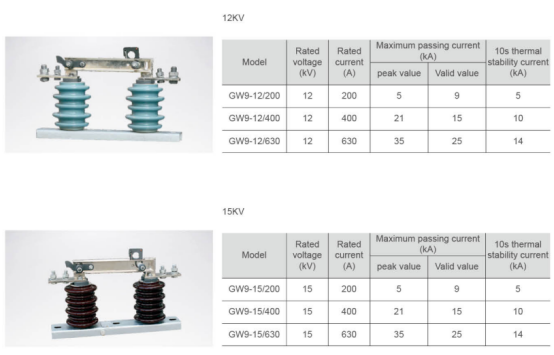
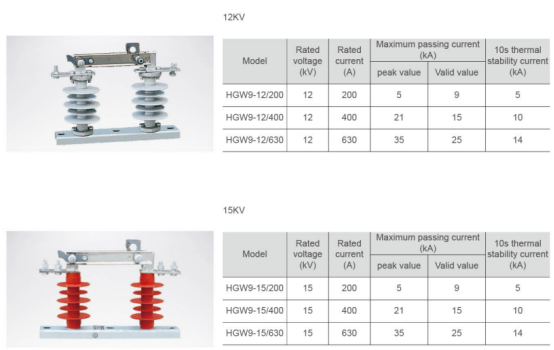
GW outdoor isolation switch
Short Description:
Isolation switch refers to the insulation distance and obvious disconnection mark between the contacts that meet the specified requirements when in the split position; A switch device that can carry the current under normal circuit conditions and the current under abnormal conditions (such as short circuit) within a specified time when in the closed position.
Product details
Product overview:
Isolation switch refers to the insulation distance and obvious disconnection mark between the contacts that meet the specified requirements when in the split position; A switch device that can carry the current under normal circuit conditions and the current under abnormal conditions (such as short circuit) within a specified time when in the closed position. (IEV441-14-05) The isolation switch we refer to generally refers to a high-voltage isolation switch, which is a type of isolation switch with a rated voltage of 1kV or above. It is commonly referred to as an isolation switch and is the most commonly used type of high-voltage switchgear. Its working principle and structure are relatively simple, but due to its large usage and high reliability requirements, it has a significant impact on the design, establishment, and safe operation of substations and power plants. The main feature of a knife switch is that it has no arc extinguishing ability and can only open and close circuits without load current.
Major role:
1) After disconnection, establish a reliable insulation gap and separate the equipment or line that needs maintenance from the power supply with a clear disconnection point to ensure the safety of maintenance personnel and equipment.
2) Change the circuit according to operational needs.
3) It can be used to separate and combine small currents in power lines, such as the charging current of bushings, busbars, connectors, and short cables, the capacitance current of switch voltage equalization capacitors, the circulating current during double busbar switching, and the excitation current of voltage transformers.
4) According to the specific situation of different structural types, it can be used to separate and combine the no-load excitation current of a certain capacity transformer. High voltage isolating switches can be divided into outdoor high-voltage isolating switches and indoor high-voltage isolating switches according to their installation methods. Outdoor high-voltage isolation switch refers to a high-voltage isolation switch that can withstand the effects of wind, rain, snow, dirt, condensation, ice, and thick frost, and is suitable for installation on terraces. According to their different insulation pillar structures, they can be divided into single column disconnectors, double column disconnectors, and three column disconnectors. Among them, the single column knife switch directly uses the vertical space as the electrical insulation for the fracture under the overhead busbar. Therefore, it has obvious advantages such as saving floor space, reducing the number of connecting wires, and having a particularly clear opening and closing state. In the case of ultra-high voltage transmission, the use of single column knife switches in substations has a more significant effect on saving floor space.